Why I chose it
I went for the Bluetti because of the specs. I bought it direct from Bluetti for £949 all in.
I own a couple of EcoFlows too, and they’re just as good. This isn’t a brand war. It’s just the one that ticked my boxes.
A full year of real use. All-electric camping first, then powering my PC and homelab 24/7 for 11 months straight.
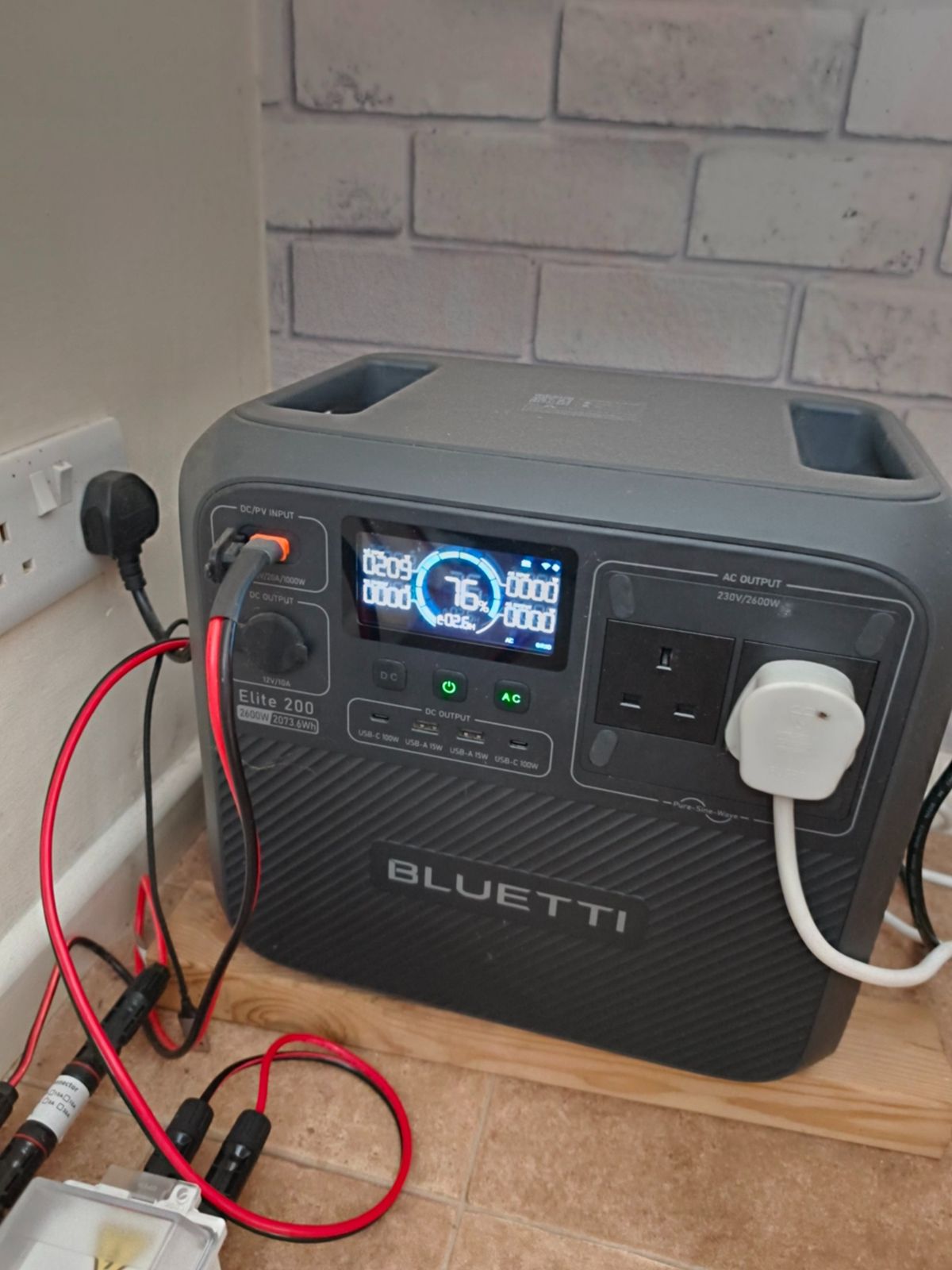
Tinkerers, campers, and anyone like me who doesn’t like seeing their tech run off grid power. With the cost of living today, the peace of mind alone has already paid for it.
£949 Worth every penny.
I went for the Bluetti because of the specs. I bought it direct from Bluetti for £949 all in.
I own a couple of EcoFlows too, and they’re just as good. This isn’t a brand war. It’s just the one that ticked my boxes.
The first proper job I gave it was camping. I run an all-electric setup, so everything goes through the Bluetti. It ran an induction hob and a 55L fridge freezer, and it powered my Starlink 24/7.
The one thing it can’t do is a normal UK kettle. Those need around 3kW and the Elite 200 V2 gives out 2,600W, so I took a travel kettle instead.
During the day I topped it up with a Renogy 400 solar blanket. That’s getting its own review later.
Bluetti’s power lifting mode lets it run higher-wattage heating gear like a full-size kettle. I tried it. The kettle took longer to boil, and I watched the battery percentage drop before my eyes, about 10% for one kettle.
The power drop was a lot more than I expected, so I keep it off. The travel kettle does the job.
Now it powers my PC and homelab around the clock. The homelab draws roughly 15W, 24/7. My PC draws about 200W when it’s on and around 450W when I’m gaming. That’s nothing for this beast.
650W of solar charges it during the day, and because I’m on Economy 7 it charges overnight on cheap electricity, ready for the next day. I limit the overnight grid charging to 4 amps, which is about 920W on UK mains (4A × 230V). It gives the battery a gentle, low-stress charge, which is better for it in the long run.
It’s been running like that for around 11 months, flat out. No restarting, nothing. Never a problem.
I’ve had power cuts while it’s been set up like this, and they mean nothing. Everything just keeps running.
The most I’ve ever seen come in from my solar is exactly 600W. Generally it’s around 450W.
And noise? There isn’t any. None at all.
It’s heavy. Bluetti lists it at 24.2kg. I can pick it up no problem, but a smaller person might struggle, so bear that in mind if you’re loading it in and out of a car for camping.
Everything I’ve plugged into it this year.
PC and homelab together (about 215W)
Gaming plus homelab (about 465W)
Rough maths, not a test. It’s based on today’s 97% battery health (about 2,011Wh), running down to my usual 5%, with about 15% knocked off for inverter losses. In real life the solar and overnight charging top it up, so I never get anywhere near flat.
I’ve worked it hard. It runs down to 5% every day and charges back to full every night, and it’s been doing that for almost a year.
That daily cycle has put a little stress on the battery. It now holds 97% of its original charge capacity.
If it keeps losing about 3% a year at the same rate, it’ll be at around 85% after five years. That’s still most of the battery after five years of being run down and filled up every single day.
For comparison, Bluetti claims 6,000+ cycles before the battery drops to 80%. At my rate of 3% a year it would reach 80% after about 6½ years, or roughly 2,400 daily cycles. That’s fewer than claimed, but batteries often lose more in the first year and then level off. I’ll keep checking and update this.
The 5-year figure is a simple straight-line estimate (3% a year × 5 years).
Bluetti’s numbers, and what I actually found.
| Bluetti says | What I found |
|---|---|
| 2,600W output | PC gaming at 450W plus the homelab is nothing for it. Not enough for a normal 3kW kettle. |
| 3,900W power lifting | Works, but the kettle was slower and it used about 10% of the battery. I keep it off. |
| 1,000W solar input | The most I’ve seen is exactly 600W from my array. Usually around 450W. |
| 16–50dB noise level | I hear nothing. No noise at all. |
| ≤15ms UPS switchover | Power cuts mean nothing. Everything keeps running. |
| 6,000+ cycles to 80% | 97% after almost a year of daily 5%-to-full cycles. |
| 24.2kg | Heavy. Fine for me, but a smaller person might struggle. |
Specs are Bluetti’s published figures. Sockets are counted from my own UK unit.
After a year of daily use.